



Connecting Data Through a Common Language: KORLOY’s DX Today and Tomorrow
Building an AI-Powered Smart Factory Through Data Standardization and PLM-Centered Connectivity
Digital Transformation (DX) in manufacturing companies is often associated with images of automated equipment and smart factories. Real-time monitoring of equipment status, automated data collection, and efficient process operations are among the most intuitive examples of DX. However, KORLOY’s vision for DX goes beyond simply automating equipment. Its true significance lies in creating a company-wide connected structure in which product information generated through R&D is accurately transferred to production, while production data and inspection results are fed back into R&D. KORLOY aims to establish an environment where, whenever changes occur in products or processes, relevant departments—including production, quality, and sales—can access the same information simultaneously and understand not only what has changed, but also the background and reasons behind those changes.
To achieve this, KORLOY is moving beyond the stage of simply establishing data touchpoints across equipment and processes. The company is organizing data that had previously been accumulated in different formats and according to different standards into a unified framework, while continuing to enhance connectivity among ERP, production systems, and systems related to quality and sales, with PLM (Product Lifecycle Management) at the center. Ultimately, KORLOY plans to build a smart factory where AI and automation can be reliably deployed on the shop floor based on this accumulated and standardized data.
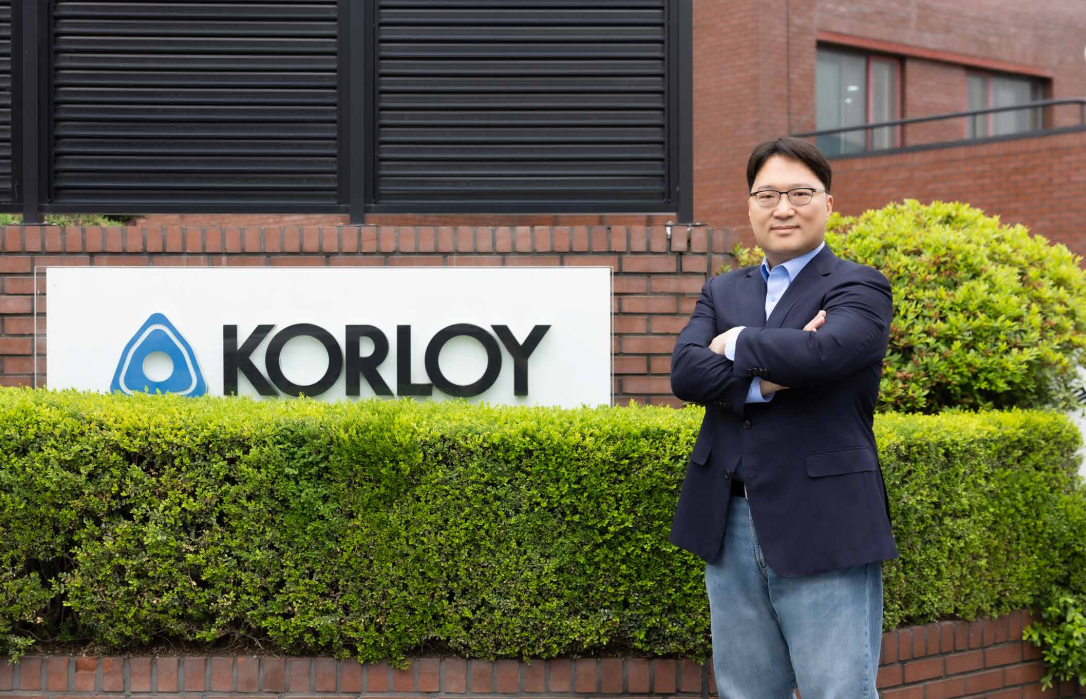
JUNGHYUN YIM, CEO of KORLOY, clearly defines the direction of DX. He has consistently emphasized, “The ultimate goal of production is the smart factory. To properly implement AI and automation, data must first be organized in a format that AI can understand.” In other words, before a company can effectively leverage AI, its data must first be organized into a common language. This is precisely where KORLOY’s DX journey begins.
This perspective is closely aligned with the management philosophy that CEO JUNGHYUN YIM has emphasized over the years. Although the wording of his New Year’s messages has varied from year to year, their direction has remained consistent.
Management principles such as “Delivering the world’s best quality and service through DX,” “Creative innovation and relentless challenge,” “Preparing for a sustainable future through challenge and innovation,” and “Improving profitability and achieving sustainable growth through efficient management” all demonstrate how KORLOY is preparing for the future. At the heart of these principles have always been technological competitiveness, customer value, efficiency, and connectivity.
In practice, KORLOY does not view DX merely as a technical initiative aimed at improving productivity. From CEO JUNGHYUN YIM’s perspective, DX is a management strategy designed to accelerate technology development, achieve more consistent quality, and enable faster and more sophisticated customer response. To expand into future industries such as aerospace, defense, energy, electrification, dental, and IT, while strengthening the competitiveness of high-value-added and premium products, product information, process data, quality standards, and mass-production results cannot remain disconnected. Only when design and production, inspection and sales are connected within a single flow can KORLOY respond more agilely to market changes and further enhance the quality and completeness of its technology development.
In this context, PLM serves as a central pillar of KORLOY’s DX strategy. While ERP is a system that integrates and manages business execution across areas such as finance, cost, production, and sales, PLM is a platform that manages master and reference information throughout the product lifecycle, including product specifications and design, manufacturing and coating, process standards, inspection criteria, and change histories. In other words, if ERP provides the execution framework for corporate operations, PLM provides the framework of standards that connects products and manufacturing. This is why KORLOY is working to connect its existing systems around PLM. Only when product and process standards are unified can production, quality, sales, and customer response be connected through the same language.
According to KORLOY, the first phase of the PLM enhancement project, carried out from August 2025 to August 2026, has been completed, and as of September 2026, the system is in the post-launch stabilization phase. While the existing PLM primarily focused on managing design assets and selected technical information, this enhancement expands its role into an enterprise-wide data platform connecting products, processes, and quality. Building on this foundation, KORLOY is strengthening the connectivity and utilization of information across R&D, production, quality, and sales.
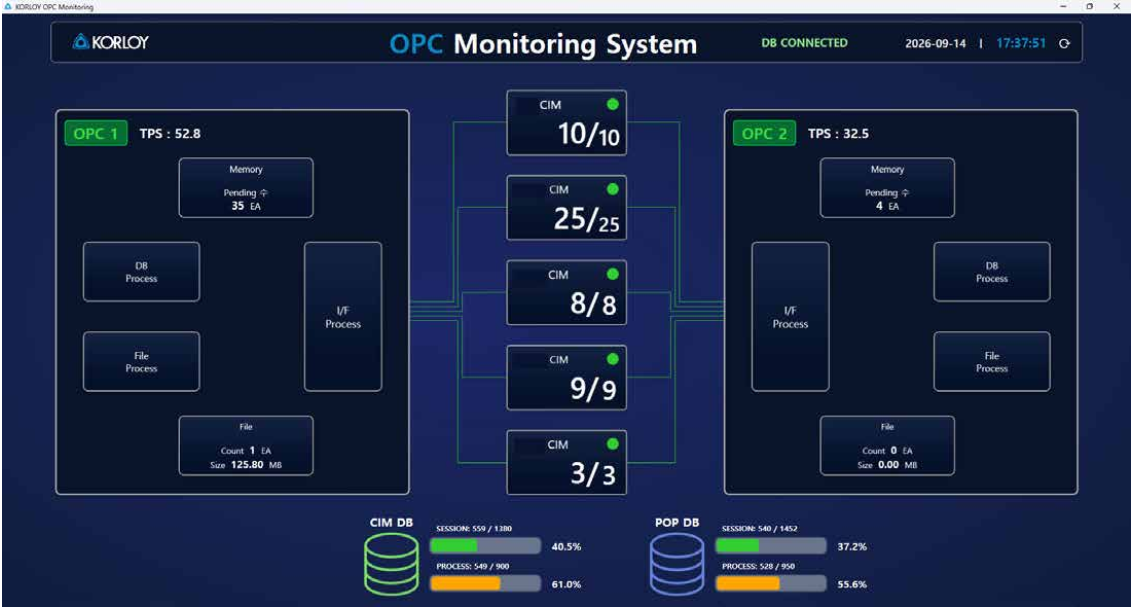
KORLOY’s OPC monitoring screen. It visualizes the CIM connection status, data processing status,
and operating status of the CIM and POP databases, enabling users to monitor the status of
the shop-floor data collection and integration system.
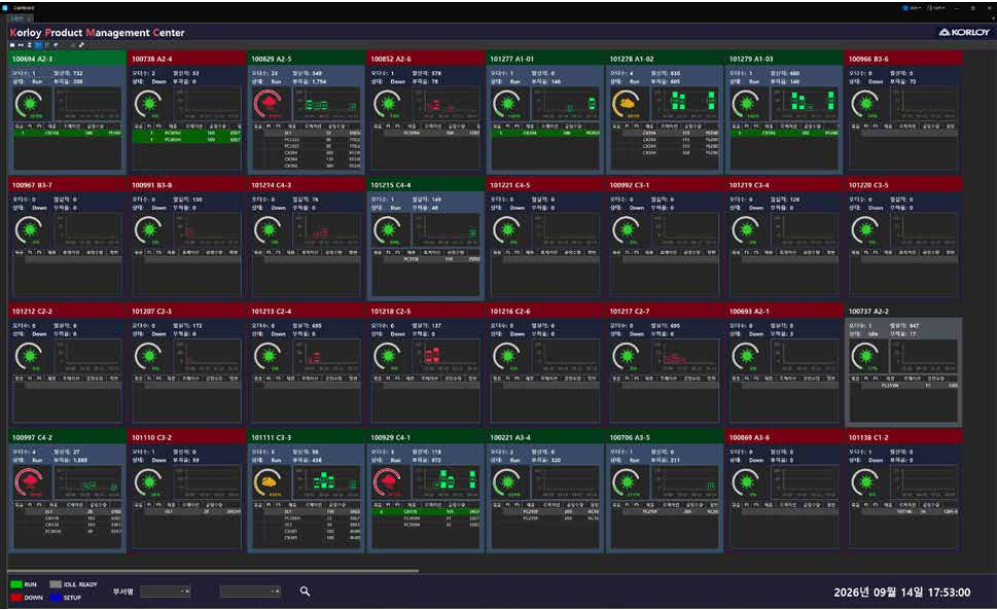
KORLOY’s production status management screen provides an at-a-glance view of
equipment operating status, production performance, utilization rates, and work information.
By visualizing shop-floor operations, it supports data-driven production management.
KORLOY has steadily built a strong foundation for DX with a focus on the manufacturing floor. Since 2019, the company has accelerated the digitalization of its production sites and established a system for collecting shop-floor data, primarily from key production equipment at its Cheongju Plant. The scope was expanded step by step, first to major press equipment in 2020 and then to grinding equipment in 2021. By increasing the points of connection between production equipment and shop-floor systems, KORLOY established a real-time data collection framework. At the same time, the company has progressively expanded its digital infrastructure across business operations and production, encompassing ERP transformation and business process innovation, upgrades to POP and OPC, the establishment of a big data foundation, enhancements to digital catalogs and CRM, improvements to collaboration systems, and the exploration of AI Agent applications. This progression can be described as a journey that began with equipment connectivity and evolved through “data collection,” “operational visibility,” “platform integration,” and ultimately “readiness for AI utilization.”
Today, key processes collect data such as production volume, quantities of good and defective products, equipment operating status, cycle time, and work history. KORLOY uses this data to analyze equipment history alongside production performance in order to identify signs of abnormalities, while also linking changes in process conditions with quality results to trace the causes of variations.
However, KORLOY does not define the completion of DX simply by the volume of data collected. What matters is that the data is interconnected, can be understood across the organization according to common standards, and ultimately leads to tangible improvements in products and processes. KORLOY’s DX is a process of improving this “quality of connectivity.” The company believes that how accurately data can be connected and interpreted is more important than how quickly it accumulates.
The “R&D Pilot Line” demonstrates how this connectivity can be applied to technology development and mass production. Around 2022, KORLOY began fully introducing DX into its pilot line, enabling the company to verify process conditions and quality characteristics during the development stage before moving into mass production. The conditions and results obtained from the pilot line are organized as reference data and compared with actual data from the initial stage of mass production. Any differences identified are then used for adjustment and improvement. The data connection framework between the two lines continues to evolve, with the goal of improving the reproducibility of development conditions in mass production and accelerating initial quality stabilization.
This approach is also closely aligned with the “efficient management” philosophy emphasized by CEO JUNGHYUN YIM. Rather than focusing solely on expanding the scale of the business, CEO JUNGHYUN YIM has consistently stressed the importance of strengthening the company’s profit structure and utilizing resources more efficiently. DX can be understood in the same context. Its practical value lies in automating repetitive tasks, connecting information scattered across departments, accelerating decision-making and execution on the shop floor, and reducing unnecessary time and costs. Ultimately, KORLOY’s DX is not simply about introducing new systems. It is an organizational transformation designed to enable smarter ways of working, faster development, and more stable production.
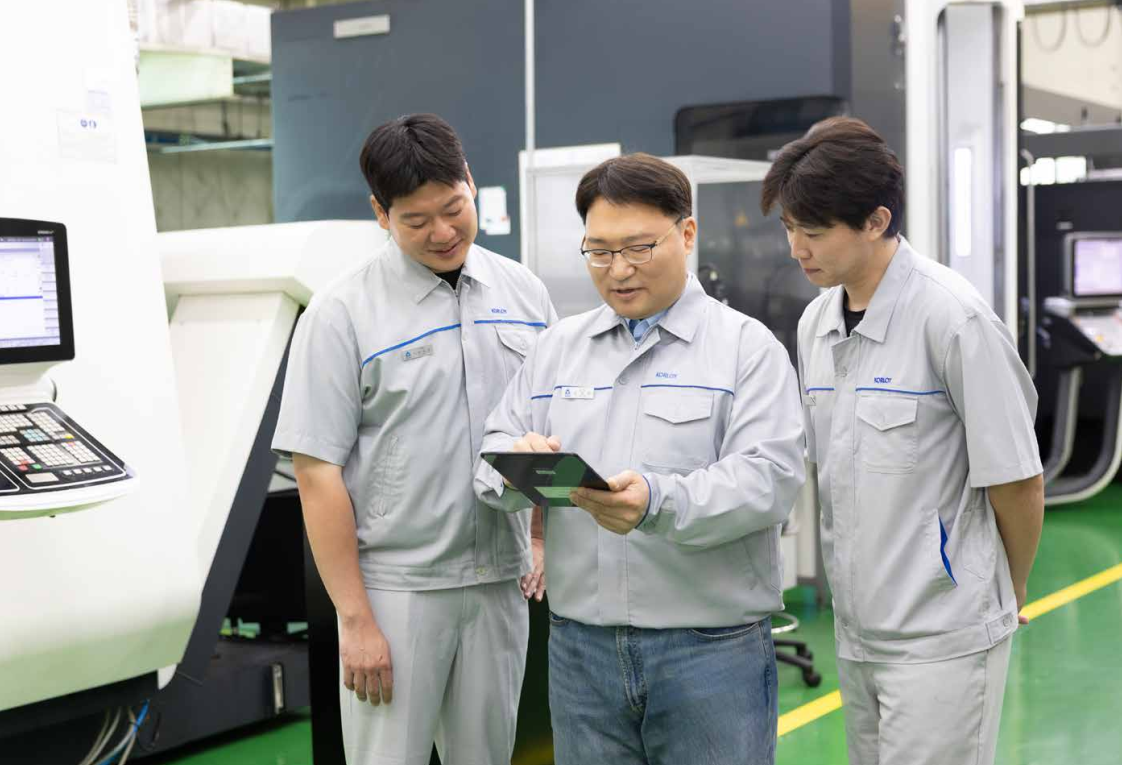
CEO JUNGHYUN YIM (center) reviews information on a tablet with employees on the production floor.
Through DX, KORLOY aims to strengthen information sharing and collaboration,
creating a work environment where employees can make decisions together based on the same information.
KORLOY stated that its RPA-based business automation initiatives have reduced approximately 3,206 hours of repetitive work annually. Following the ERP transformation, major sales-related reports also showed processing speed improvements of up to five times. Collaboration systems and automated voice meeting transcription are likewise improving the efficiency of recording and sharing meeting content, as well as organizing follow-up actions. These changes reduce the time spent on repetitive tasks and create an environment in which employees can focus more fully on their core responsibilities.
Another noteworthy aspect is that KORLOY does not view DX as technology separate from people. CEO JUNGHYUN YIM has consistently emphasized communication and collaboration, respect for talent, customer value, and happiness-oriented management. This philosophy extends to the belief that DX should also be a system designed for people. Connecting data does not simply mean connecting systems. It also means creating an environment in which R&D and production sites, as well as quality and sales organizations, can communicate more smoothly and make decisions together based on more accurate information. In this sense, as system advancement should also contribute to the maturity of organizational culture, KORLOY’s DX represents not only technological innovation but also innovation in the way people work.
From the customer’s perspective, the value of DX is equally clear. As data-driven operations become more firmly established, product quality can become more consistent, delivery reliability can improve, and technical response times can be shortened. Furthermore, as digital catalogs, CRM, and technical sales systems become more seamlessly integrated, customers will be able to access the product and technical information they need more quickly, while KORLOY will be able to respond with more precise solution proposals. In other words, DX that begins with internal efficiency ultimately leads to greater customer value. Going forward, KORLOY plans to further enhance its technical support by connecting customers’ machining data with its own product and process data to provide cutting condition recommendations, predict tool life, and optimize application processes.
KORLOY’s vision for an AI-powered smart factory should also be understood within this philosophy. AI does not automatically deliver results simply because large volumes of data have been collected. The meaning of each type of data must be clearly defined, information from R&D, production, and quality must be connected without conflict, and knowledge and experience from the shop floor must be systematically converted into digital information. This is precisely the foundation KORLOY is building. Rather than prioritizing sophisticated technologies themselves, the company is first establishing data standards and connectivity. Rather than focusing solely on the speed of automation, it is first improving the accuracy and effectiveness of how technology is applied.
KORLOY is currently evaluating the potential internal use of AI Agents in areas such as business support and knowledge utilization, while building experience through pilot applications. In the short term, the company plans to promote the use of business-support AI while ensuring data consistency and stable system connectivity. In the medium term, it intends to strengthen predictive and recommendation capabilities across quality, equipment, and production. Over the long term, the goal is to move closer to a smart operating system capable of autonomous optimization, built on an enterprise-wide data platform.
Ultimately, KORLOY’s DX is an innovation defined less by “what has been automated” than by “what has been connected.” It is about bringing R&D and production, quality and sales, people and systems, and experience and data together through a common language. On this foundation, KORLOY aims to achieve faster technology development, more stable production, and greater customer value. This represents both the present and the future of KORLOY’s DX.
For CEO JUNGHYUN YIM, DX is not simply digitalization. It is both a practical and fundamental strategy for a manufacturing company to achieve sustainable growth and profitability, as well as a language of transformation that elevates KORLOY’s technological competitiveness and organizational culture to the next level. KORLOY is now evolving from a company that simply accumulates more data into one that connects data more effectively. At the end of that journey lies a future defined by a smart factory combining AI and automation, faster technology development, more consistent quality, and greater customer trust.
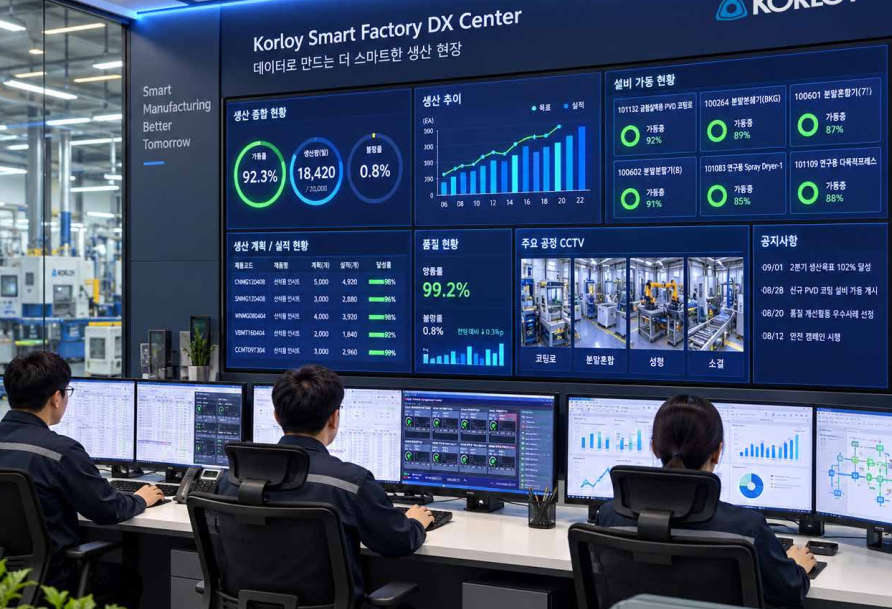
Building on data connectivity and system stabilization, KORLOY is preparing a smart factory that will
evolve from business-support AI to predictive and recommendation capabilities in manufacturing,
and ultimately to autonomous optimization. (This is an AI-generated image provided for illustrative purposes.)

